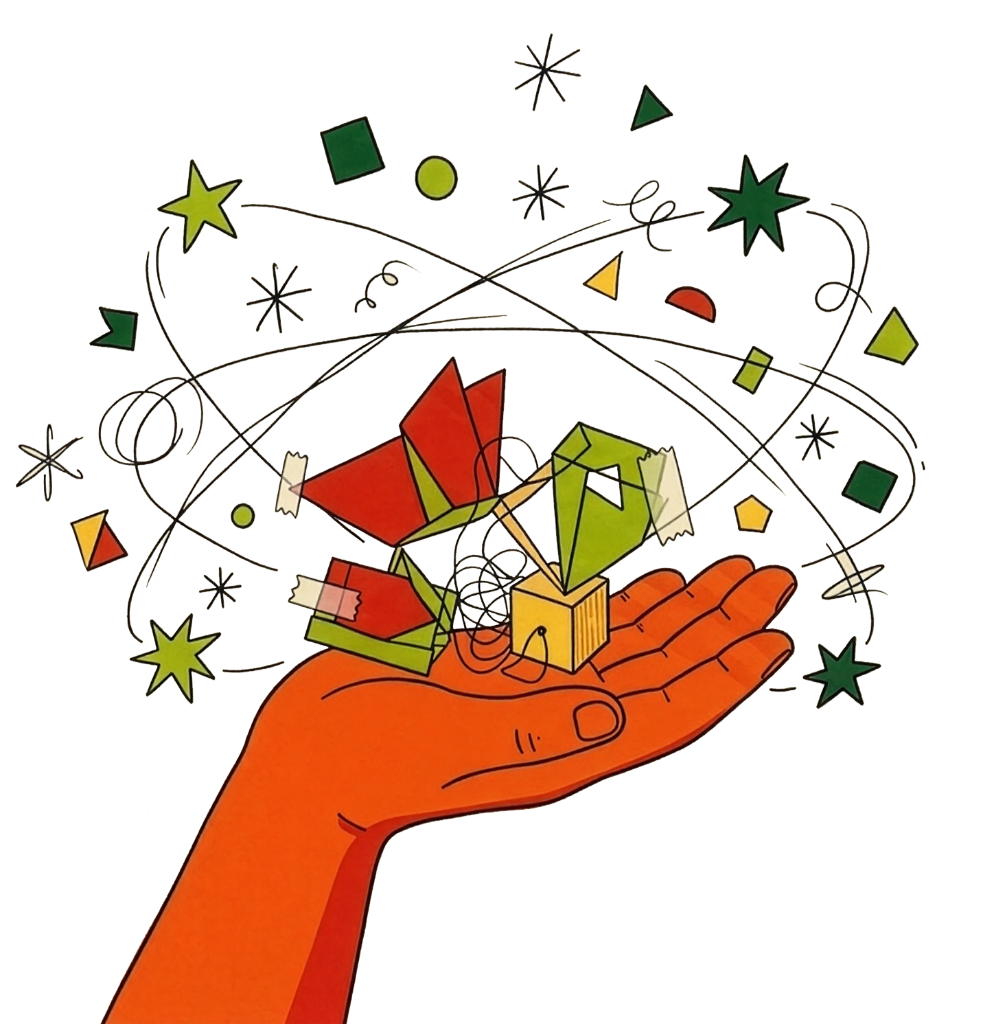
Confidencecannot bedownloaded.It's made.
Thinking Hands is a creativity workshop for kids — a place to think, make, and discover with their own hands, and build the quiet confidence that only comes from doing.
A generation is growing up with instant answers.
They'll never know a world without them. That's not a tragedy — it's just the new baseline. The question is what gets built in a child when the answering is taken care of.
The honest answer: not much, unless we're deliberate about it. Judgment, originality, and the quiet confidence that comes from finishing something hard — these don't develop from watching. They develop from doing. From making, breaking, and building again.
That's what this workshop is for.
Three pillars hold the whole thing up.

Creative Courage
The willingness to make the first mark. To put the ugly draft on the table. To be seen making.
Start messy →Resilient Thinking
When it breaks — and it will break — you build. Iteration as identity, not inconvenience.
Try again →Original Contribution
Not a remix of the feed. Something that carries your fingerprint and could only have come from you.
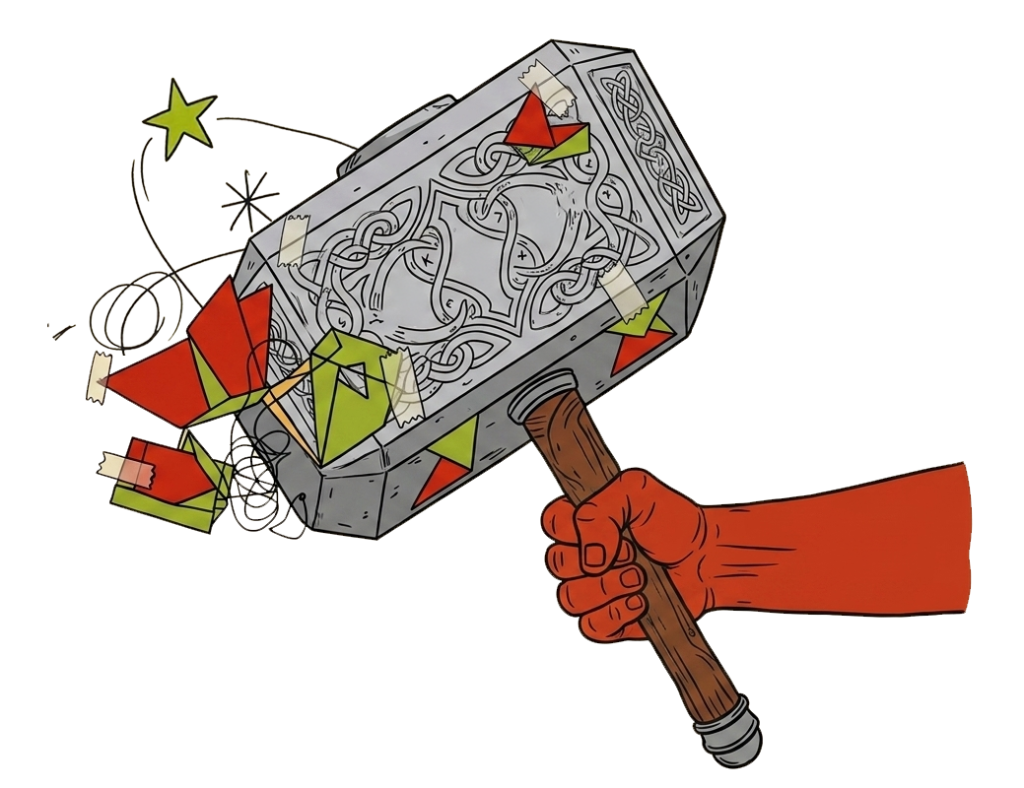
Sign your work →When it breaks,
you build.
The lesson isn't in the building. It's in the rebuilding, and in the child who walks out a little harder to discourage than the one who walked in.
The method is made, not said.
A five-principle field manual for what happens between the bell and the build.
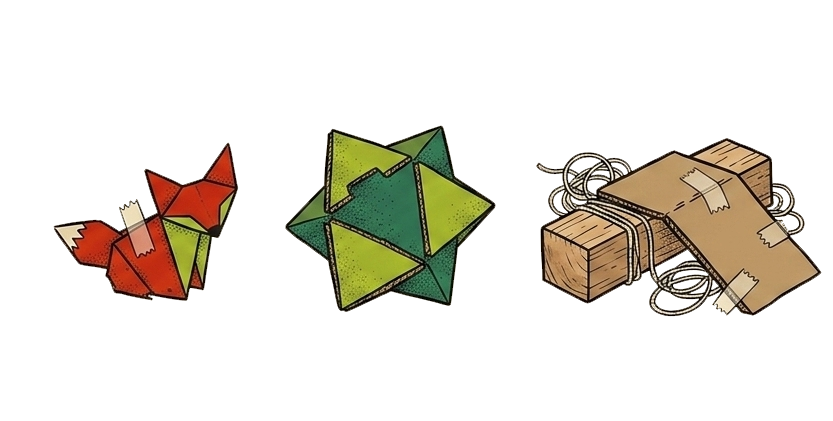
Hands First
Every session starts with material in hand, not information on screen. Understanding arrives through doing.
Kolb · PapertProductive Failure
We design for the moment things go wrong. The pivot is the pedagogy, not the obstacle to it.
Dweck · KapurVisible Thinking
The artifact is the argument. What you make becomes evidence of how you thought.
Ritchhart · PerkinsSafe Exposure
Creative risk requires psychological safety. We build rooms where not-yet-knowing is the norm.
Edmondson · MalchiodiOwned Outcomes
Nothing anonymous. Every maker signs their work and stands behind it.
Papert · HarelBuilt on shoulders, not vibes.
The method draws on established research — not corporate frameworks.
Learning happens in cycles of doing, reflecting, conceptualizing, and experimenting again.
Abilities grow with effort. 'I can't do this' becomes 'I can't do this yet.'
Making is a way of knowing — especially for things that don't come out cleanly in words.
People take creative risks only when it's safe to be seen not-yet-knowing.
We learn best when we build something external that we can share, show, and argue about.
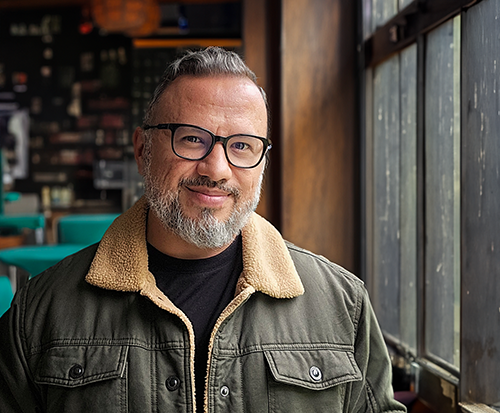
Built by a maker. For makers.
Andrei Bonilla doesn't teach; he facilitates environments for high-stakes creative problem-solving. With two decades of leadership directing creative work for brands like Nike, IKEA, Google, Meta, and Bayer, Andrei brings the same design-thinking rigor used in global innovation labs to the development of the next generation.
His career is defined by the intersection of high-level strategy and material play. He holds a Design Thinking certification from Universidad de Salamanca and a Leadership and Innovation credential from MIT Professional Education. These academic foundations complement his recognition as a Florence Biennale Fifth Prize winner for New Media Art and a Cannes Lions nominee.
As the author of the book Once (Eleven) and a seasoned facilitator of creative workshops across the USA, London, the Netherlands, and Switzerland, Andrei treats "Thinking Hands" not as a classroom, but as a sandbox for the future of human-led intelligence. He is a firm believer that in an era of automated answers, the most critical competitive advantage is the ability to break, pivot, and rebuild with your own hands.